For far less cost than comparably powerful pedals, Klowra’s pedals offer a significant amount of premium features.
Klowra’s Pedals Are Both Familiar And New To The Marketplace
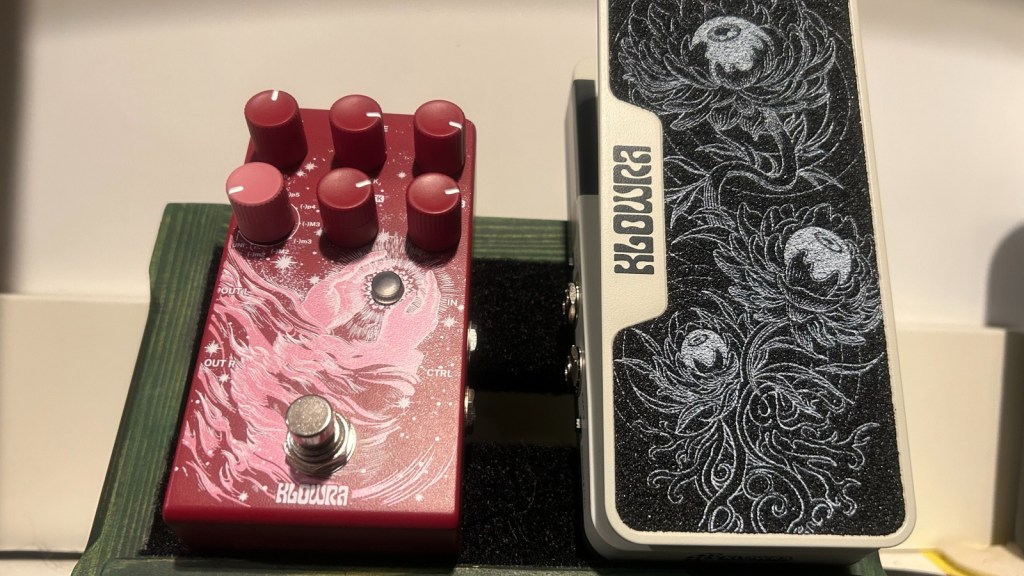
When I first saw the Klowra pedal designs, I was struck by how much they reminded me of the ALABS Audio pedals I had previously reviewed. Turns out, there is some shared DNA after all, as the design team behind Klowra came over from the ALABS Audio team. Klowra hit me up and asked if I’d check out the Vein Pitch Shifter as well as their newest release, the Mantra Dual Expression pedal. The Vein is a little more expensive than the ALABS Orbit was, coming in at $149.99 USD, as you will see later though, I like this pedal a lot more than I liked the Orbit. The Mantra is little more affordable, but still somewhat pricey for an overseas expression pedal at $99.99 USD, with both available on Amazon.
Key Features To Know About (There Are A Lot)
Let’s start with the Vein, which has a lot to unpack. I want to be up front, I did not do as deep a dive as Ryan from 60 Cycle Hum did in his demo, so go check that out here after watching my demo! This is a true stereo pitch shifter, with input for external control via expression pedal. The Vein also has momentary or latching modes, meaning you can hold the footswitch down to activate the ramping features – controlled by the two glide controls (two ramping effects). There’s also rate, detune, and mix controls plus a rotary for moving through the different pitch options. The detune knob provides a nice warm warble/reverb into the mix. There’s also a way to trigger the low octaves by holding the light and using the rotary in combination. This pedal will take you a few moments to figure out, but it also will not get boring in particularly quick order. For more of a plug-and-play guy like me, I’m sticking around the octave and 5th voicings mostly, as I just want to dial in some quirky sounds for ambience and background layers. In the most simplistic way, this is sort of like a chorus pedal and simplified whammy in a smaller enclosure.
The Mantra is a little more straight forward, but with one fun twist. You can connect this to two pedals simultaneously via the two output jacks and you can change the directionality of the expression effect. That means you can use the little switch to set the direction of the effect i.e. foot down ramps up, or foot down ramps down. It may take a second to read that and understand it, but it’s not complex in practice. The Mantra was made in conjunction with Hotone, whose expression pedals I’ve used in the past briefly.
Brief Demo
Note: I’m in the middle of moving and packing up my gear, so a full demo showcasing these two pedals as part of my pedalboard will be coming sometime in March, with updates to this article to follow. All the pedals I’ve reviewed so far in 2026 will be put on a pedalboard and demonstrated as a complete rig, showcasing the ways I use them at home!
My Thoughts
In full honesty, a lot of the features of the Vein go slightly underappreciated in my presence because I have very simplistic preferences for pitch pedals. I use only a handful of the setting that are available, and accessibility tends to woo me more than versatility. However, I still have found the Vein to be nothing short of impressive. I was really not super impressed with the ALABS iteration of this pedal, but the Vein builds on that in a meaningful way. The dual glide controls are a big upgrade, especially for folks who are looking for Chase Bliss-like glitchiness, and the tracking feels much smoother on the Vein. That’s the key selling point here; this pedal can have as much depth as you want it to. I just want a few octave sounds, it does that beautifully (especially with the Mantra). But if you want a rich, sonic, exploration of sound and space, this pedal will compete with a lot of pricier boutique options. While the $150 price tag may seem a touch steep, relative to what the ALABS pedals went for, I actually still think this is a good value. For a pitch shifter with this many features from a typical boutique firm, we’re looking at $200 USD and up, with a likely emphasis on the up.
The Mantra is more simple and straightforward, but has been perfectly suitable. I haven’t had the chance to try it with pedals outside the Klowra family, and it’s unclear if it will work as smoothly based on the required calibration. However it is so simple, just flex the treadle a few times after plugging in, that it must work. But all my pedals are packed up for my impending move home so stay tuned for an update to this review! The Mantra feels absolutely rock solid and I’m eager to add this and the Vein to my gigging board and see how things hold up in a sweaty bar or two. Overall, I’m very impressed with the two pedals from Klowra even though I don’t think I’m the exact target audience for these. If you are feeling the economic squeeze and want one of those pedals that feels like a bottomless pit of sound scaping, pass up on the boutique domestic brand and consider the Klowra Vein!
Discover more from Guitars For Idiots
Subscribe to get the latest posts sent to your email.
